Finding My People: The Power of Disability Community
Finding your people doesn’t erase the challenges of living with a disability. But it does change how those challenges feel.
Lynda
4/20/20263 min read
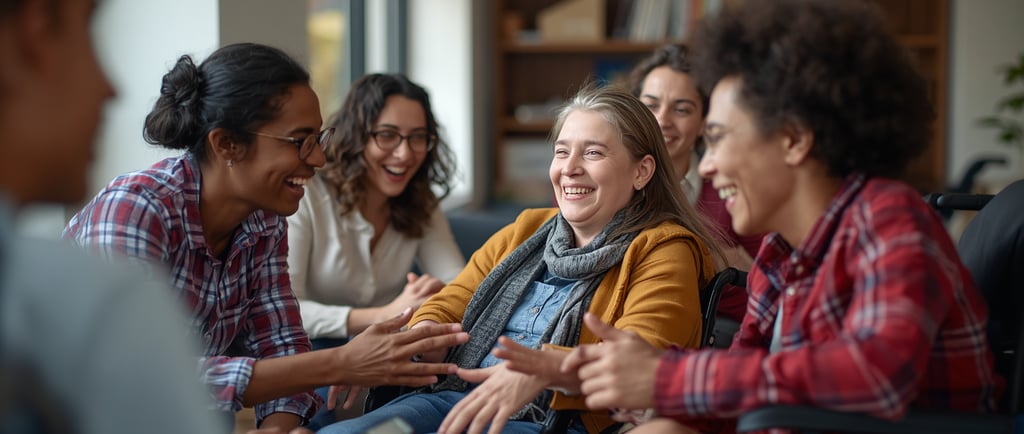
There’s a moment many people with disabilities experience—sometimes quietly, sometimes all at once—when you realize you’ve been translating your life for everyone around you. Explaining symptoms. Justifying limitations. Softening hard truths so others feel comfortable.
And then, one day, you meet someone who just… gets it.
No long explanations. No awkward pauses. No need to make your reality more “palatable.” Just understanding.
That’s what finding your people feels like. And it can change everything.
The Relief of Being Understood
Living with a disability—whether visible or invisible—can be isolating in ways that are hard to describe. Even in supportive families or friendships, there’s often a gap between empathy and lived experience.
Disability communities help close that gap.
It’s the friend who doesn’t question why you canceled plans last minute.
The group chat where “today is a low-energy day” needs no further explanation.
The shared humor that only makes sense if you’ve lived it.
This kind of understanding isn’t just comforting—it’s grounding. It reminds you that your experiences are real, valid, and shared.
Why Community Matters (More Than We Realize)
Connection isn’t just emotional—it’s practical.
Being part of a disability community often means access to knowledge you won’t find in a brochure or a doctor’s office:
Which tools actually help in real life
How to navigate systems that weren’t designed with you in mind
What to say (and not say) in medical or workplace settings
Where to find resources that make daily life easier
It’s lived wisdom. And it’s powerful.
Community also plays a huge role in self-acceptance. When you see people living full, meaningful lives—on their own terms—it expands what feels possible for you, too.
Finding Your People (Without Overwhelm)
If you haven’t found your community yet, it can feel intimidating to start. The good news? It doesn’t have to be all at once.
Start small and low-pressure:
Follow disability advocates or creators who share your experience
Join one online group or forum and simply observe at first
Attend a local event, workshop, or support group if accessible
You don’t need to dive in head-first. Listening is a valid first step.
Look for alignment, not just similarity.
Two people can share a diagnosis and have completely different outlooks. Pay attention to spaces that feel supportive, respectful, and empowering—not draining or discouraging.
Give yourself permission to leave spaces that don’t fit.
Community should feel like a place you can exhale, not perform.
Building Meaningful Connections
Once you find spaces that feel right, connection tends to grow naturally—but it can still take intention.
Try:
Commenting on posts that resonate with you
Sharing a small part of your own experience
Reaching out one-on-one when something feels especially relatable
You don’t have to share everything to belong. Even small moments of honesty can open the door to deeper connection.
And remember—community isn’t about having a huge circle. Sometimes it’s just one or two people who truly understand. That’s enough.
The Unexpected Power of Being Seen
There’s something quietly transformative about being seen without explanation.
It softens the edges of isolation.
It makes hard days feel less heavy.
It reminds you that your life—exactly as it is—is part of a much larger, shared story.
And over time, something shifts. You’re not just receiving support—you’re offering it, too. Your experiences, your insights, your voice… they become part of someone else’s lifeline.
A Final Thought
Finding your people doesn’t erase the challenges of living with a disability. But it does change how those challenges feel.
They become less lonely.
More navigable.
More human.
Because when you find a space where you don’t have to explain your existence, you gain something incredibly valuable:
The freedom to simply be.
And that kind of belonging?
It’s powerful.
Be Gentle With Yourself.
Connect
Reach out anytime with suggestions, comments, for support or questions. We enjoy hearing from our community!
welcome@theabilityharbor.com
© 2026. All rights reserved.
Follow us on Instagram!
Founder's Story
As a medical professional, I spent my entire career caring for people at their most vulnerable. I had the privilege of standing beside families as they welcomed new life and holding hands as others said goodbye to someone they loved dearly. My work was never just a job—it was a calling, and I poured my heart and soul into it.
In 2005, everything changed. I was diagnosed with a brain tumor, a blow I never expected. Overnight, I found myself on the other side of the medical world—the patient instead of the professional. Over the years, I faced multiple surgeries, chemotherapy trials, and the latest radiation therapies. Each offered hope, but none could stop the tumor’s relentless growth. Eventually, I had to face the painful truth that I could no longer continue the work I loved and depended on. That loss brought its own kind of grief.
Not long after my third surgery and another round of radiation, I experienced a medical emergency at home—status epilepticus. Simply put, it’s a seizure lasting more than five minutes or a series of seizures without regaining consciousness in between. Quick treatment is essential to prevent permanent injury or even death. They estimated I was on the floor for several hours before help arrived.
When I woke up four days later, everything felt unfamiliar. My memory was clouded, my body unsteady, and I had no idea what had happened. What I did learn was that my life had changed permanently. I now had uncontrolled epilepsy caused by extensive scarring from surgeries and radiation.
I spent the next three months in a neurological rehabilitation program. I relearned how to balance and move. I worked through cognitive challenges. I learned how to adapt and rebuild my independence. It was a long, humbling journey—but I wasn’t alone. With an incredible support network and a determination to keep moving forward, I slowly began piecing my life back together.
Light and Love.