Focus On Your "Can", Not On Your "Can't"
There’s a quiet kind of courage in shifting your focus—from what’s been taken, to what still remains. Sometimes, we need a wider learning curve to truly understand what that means
Lynda
4/26/20262 min read
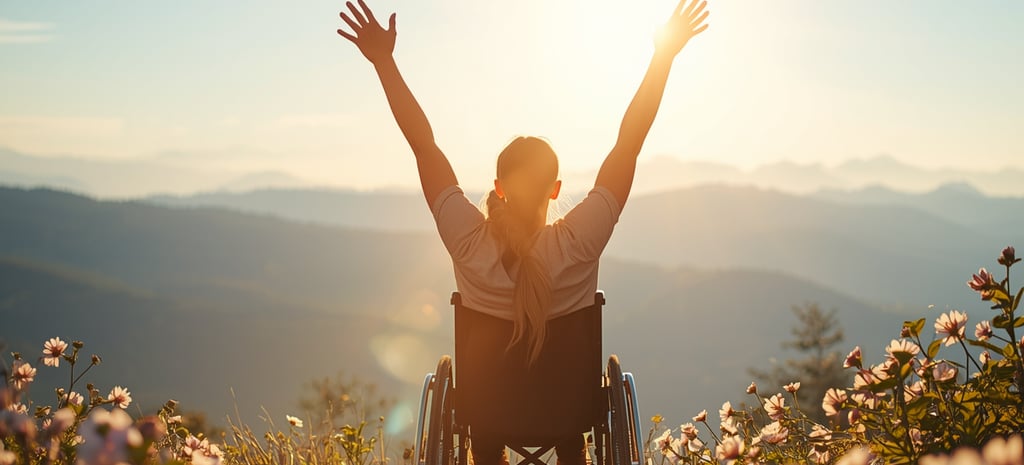
There’s a quiet kind of courage in shifting our focus—from what’s been taken, to what still remains.
Stephen Hawking once shared this advice: “Concentrate on things your disability doesn't prevent you doing well, and don't regret the things it interferes with.” It’s a powerful statement—but for some of us, it comes with a caveat. Sometimes, we need a wider learning curve to truly understand what that means. It isn’t a simple mindset change or a motivational quote that suddenly clicks. It’s a process. A lived, layered experience of loss, adaptation, frustration, and—eventually—redefinition.
Because before we can focus on what we can do, we often have to grieve what we can’t.
That grief is real. It shows up in small moments—a task that used to be easy, now requiring help. A plan canceled. A version of life that looks different than expected. Ignoring that grief doesn’t make it disappear; it just makes the journey lonelier.
But over time, something does begin to reposition.
We start to notice what is still possible. Not in a forced, overly optimistic way—but in a grounded, honest one. Maybe our pace is different now. Maybe our strengths look different. Maybe our victories are quieter, and less visible to the outside world. But they are no less meaningful.
Focusing on what we can do doesn’t mean pretending limitations don’t exist. It means choosing not to let them define the entirety of our story.
It might look like:
Finding new ways to express creativity when old methods no longer work.
Building deeper relationships because we’ve learned how to communicate our needs.
Developing resilience that others may never fully understand.
Discovering strengths we didn’t know we had, simply because we had to.
For some, this shift takes time—and that’s okay. When our world changes, our identity often has to catch up. We're not just adjusting routines; we’re redefining how we see ourselves. And that’s not a small task.
There’s also a quiet pressure in society to “stay positive” or “make the best of it.” But real strength isn’t about constant positivity. It’s about honesty. It’s about acknowledging the hard days while still leaving room for possibility. Focusing on what we can do is not about shrinking our reality—it’s about expanding it.
It’s saying: "Yes, this is part of my life. But it is not all of my life."
It’s recognizing that ability is not a fixed concept. It evolves. It adapts. It surprises you. What we can do today might look different than yesterday—and different again tomorrow. That doesn’t make it less valuable. If anything, it makes it more so.
And sometimes, the most important things we can do aren’t the ones the world measures. They’re the internal shifts:
Choosing to try again.
Allowing ourself to rest without guilt.
Asking for help when needed.
Letting go of comparisons.
These are not small things. They are acts of strength, to be seen as courage and self-growth.
So if you’re still in that space—somewhere between what was and what is—give yourself room to learn. A wider learning curve doesn’t mean we’re behind. It means we’re navigating something complex, something deeply human.
And in time, what you can do may not just feel like a consolation—it may become a source of pride.
It doesn't replace what was lost, but it does represent everything you’ve adapted, endured, and grown into.
Your story isn’t defined by limitation. It’s defined by how we continue to live within—and beyond—it.
Lasting Love and Fulfillment.
Connect
Reach out anytime with suggestions, comments, for support or questions. We enjoy hearing from our community!
welcome@theabilityharbor.com
© 2026. All rights reserved.
Follow us on Instagram!
Founder's Story
As a medical professional, I spent my entire career caring for people at their most vulnerable. I had the privilege of standing beside families as they welcomed new life and holding hands as others said goodbye to someone they loved dearly. My work was never just a job—it was a calling, and I poured my heart and soul into it.
In 2005, everything changed. I was diagnosed with a brain tumor, a blow I never expected. Overnight, I found myself on the other side of the medical world—the patient instead of the professional. Over the years, I faced multiple surgeries, chemotherapy trials, and the latest radiation therapies. Each offered hope, but none could stop the tumor’s relentless growth. Eventually, I had to face the painful truth that I could no longer continue the work I loved and depended on. That loss brought its own kind of grief.
Not long after my third surgery and another round of radiation, I experienced a medical emergency at home—status epilepticus. Simply put, it’s a seizure lasting more than five minutes or a series of seizures without regaining consciousness in between. Quick treatment is essential to prevent permanent injury or even death. They estimated I was on the floor for several hours before help arrived.
When I woke up four days later, everything felt unfamiliar. My memory was clouded, my body unsteady, and I had no idea what had happened. What I did learn was that my life had changed permanently. I now had uncontrolled epilepsy caused by extensive scarring from surgeries and radiation.
I spent the next three months in a neurological rehabilitation program. I relearned how to balance and move. I worked through cognitive challenges. I learned how to adapt and rebuild my independence. It was a long, humbling journey—but I wasn’t alone. With an incredible support network and a determination to keep moving forward, I slowly began piecing my life back together.
Light and Love.