Types of Disabilities: Visible, Invisible, and Misunderstood
When most people hear the word disability, they picture something they can see—like a wheelchair, cane, or mobility device. But the disability community is far broader, more diverse, and far more complex than what meets the eye.
4/10/20262 min read
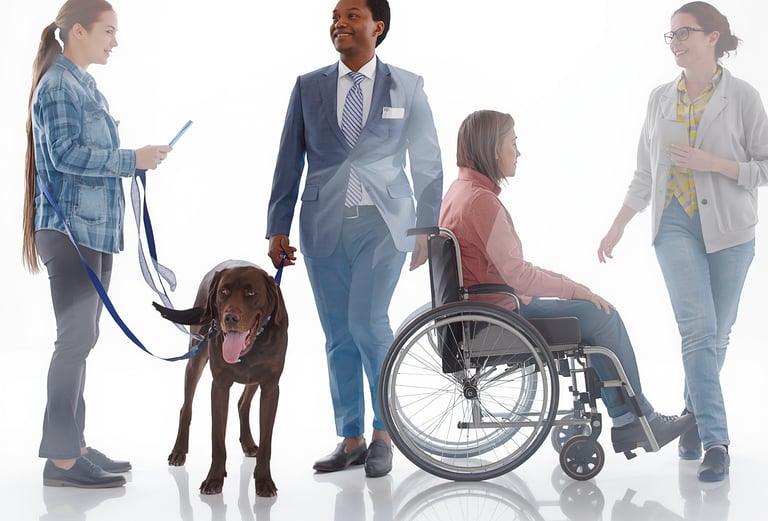
When most people hear the word disability, they picture something they can see—like a wheelchair, cane, or mobility device. But the disability community is far broader, more diverse, and far more complex than what meets the eye. Some disabilities are undeniably visible. Some are completely hidden. And many fall into a space of being misunderstood, underestimated, or overlooked entirely.
Understanding this spectrum doesn’t just build awareness—it opens the door to compassion, better accessibility, and a world where people feel seen without having to constantly explain themselves.
Visible Disabilities: When the World Assumes It Knows Your Story
Visible disabilities are the ones people can identify right away. They include mobility impairments, limb differences, neuromuscular conditions, and sometimes neurological or developmental disabilities. These individuals often navigate a world that responds before even hearing them speak—whether through assumptions, stares, unsolicited help, or over-simplified judgments.
The visibility does allow for quicker recognition of accessibility needs, but it also invites a level of public scrutiny no one asks for. People with visible disabilities often carry the emotional weight of constantly being “on display,” their bodies becoming symbols rather than simply being their own. True inclusion means honoring personal autonomy, offering help only when asked, and remembering that visibility doesn’t equal understanding.
Invisible Disabilities: Unseen, But Deeply Felt
Invisible disabilities are every bit as real, impactful, and complex—but they often come with the burden of being doubted or dismissed. These include chronic pain conditions, autoimmune disorders, epilepsy, mental health conditions, ADHD, learning disabilities, sensory processing differences, traumatic brain injuries, hearing loss, and many others.
Because the disability can’t be seen, individuals frequently face comments like:
“But you don’t look disabled.”
“You seem fine to me.”
“Are you sure it’s that bad?”
The challenge isn’t only managing symptoms—it’s managing disbelief.
People living with invisible disabilities often become experts at masking their discomfort, pushing through pain, or downplaying their needs simply to avoid judgment. True support begins with trust: believing people when they describe their experience, honoring their boundaries, and remembering that health is not always visible on the surface.
Misunderstood Disabilities: The Gray Space Too Many Fall Into
Some disabilities are neither fully visible nor invisible—they are misunderstood.
This includes a wide range of neurodivergent conditions, developmental disabilities, psychiatric disabilities, and medical conditions that fluctuate.
Misunderstood disabilities often come with stereotypes such as:
“You’re being dramatic.”
“You just need more discipline.”
“But you were fine yesterday.”
“You don’t look that disabled.”
This group faces the double challenge of being visible enough to attract judgment, but not visible enough to attract support. They may use assistive devices some days and not others. They may speak clearly and confidently in one moment, yet become overwhelmed and need accommodations the next.
The truth is simple: disability is not linear. It's not predictable. And it’s not something a stranger can accurately assess in passing.
Why This Distinction Matters
Understanding visible, invisible, and misunderstood disabilities helps create communities that are more compassionate and accessible. It reminds us that disability is not a single experience—it’s a spectrum of identities, challenges, strengths, and adaptations.
Here’s what we can all do:
Believe people the first time.
Stop assuming health based on appearance.
Offer support that respects autonomy.
Advocate for universal accessibility—because everyone benefits.
Leave room for nuance. Disability is not one-size-fits-all.
A More Understanding World Starts Small
Whether a disability is plainly visible, completely unseen, or simply misunderstood, one truth remains: every person deserves dignity without explanation. When we recognize the diversity within the disability experience, we shift the culture toward empathy, equity, and belonging—one conversation at a time.
Connect
Reach out anytime with suggestions, comments, for support or questions. We enjoy hearing from our community!
welcome@theabilityharbor.com
© 2026. All rights reserved.
Follow us on Instagram!
Founder's Story
As a medical professional, I spent my entire career caring for people at their most vulnerable. I had the privilege of standing beside families as they welcomed new life and holding hands as others said goodbye to someone they loved dearly. My work was never just a job—it was a calling, and I poured my heart and soul into it.
In 2005, everything changed. I was diagnosed with a brain tumor, a blow I never expected. Overnight, I found myself on the other side of the medical world—the patient instead of the professional. Over the years, I faced multiple surgeries, chemotherapy trials, and the latest radiation therapies. Each offered hope, but none could stop the tumor’s relentless growth. Eventually, I had to face the painful truth that I could no longer continue the work I loved and depended on. That loss brought its own kind of grief.
Not long after my third surgery and another round of radiation, I experienced a medical emergency at home—status epilepticus. Simply put, it’s a seizure lasting more than five minutes or a series of seizures without regaining consciousness in between. Quick treatment is essential to prevent permanent injury or even death. They estimated I was on the floor for several hours before help arrived.
When I woke up four days later, everything felt unfamiliar. My memory was clouded, my body unsteady, and I had no idea what had happened. What I did learn was that my life had changed permanently. I now had uncontrolled epilepsy caused by extensive scarring from surgeries and radiation.
I spent the next three months in a neurological rehabilitation program. I relearned how to balance and move. I worked through cognitive challenges. I learned how to adapt and rebuild my independence. It was a long, humbling journey—but I wasn’t alone. With an incredible support network and a determination to keep moving forward, I slowly began piecing my life back together.
Light and Love.